
Andre Anthony Dennis
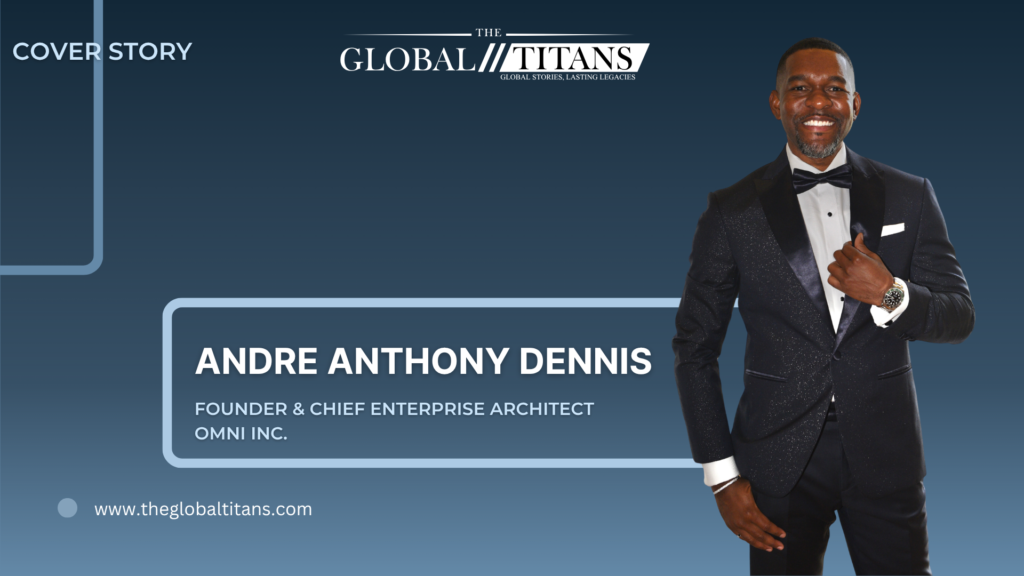
Andre Anthony Dennis: Creating Intelligent Enterprises That Endure
“Leadership is not about becoming indispensable. It is about building organizations where no single individual needs to be.” — Andre Anthony Dennis
For more than two decades, Andre Anthony Dennis has been quietly influencing the evolution of global enterprise operations not simply by introducing new technologies, but by challenging how organizations think about leadership, transformation, and performance itself.
His work spans some of the world’s most recognized organizations, including Amazon, Apple, Walmart, UPS, PayPal, and Staci Americas. Across each environment, regardless of industry or geography, Andre has pursued the same objective: designing intelligent systems where people, technology, and purpose operate together rather than independently.
While artificial intelligence, robotics, predictive analytics, and automation continue redefining modern business, Andre believes the greatest transformation taking place is not technological.
It is human.
Technology, he often explains, is an amplifier. It accelerates execution, strengthens visibility, and expands capability but its value is ultimately determined by the principles guiding its implementation and the people entrusted to use it.
That philosophy has become the foundation of his career and one of the defining reasons he is recognized as an Iconic Leader Advancing the Future of Supply Chain Intelligence and Automation – 2026
From Jamaica to Global Enterprise Leadership
Looking back on his early years, Andre does not describe leadership in terms of titles or authority.
Instead, he remembers lessons rooted in discipline, service, accountability, and integrity.
Growing up in Jamaica, he was fortunate to be surrounded by mentors and institutions that emphasized character before achievement. Through Scouting, the Jamaica Combined Cadet Force, his academic journey, fraternity leadership, and later professional experiences, he learned perseverance, respect, discipline, and responsibility long before entering the corporate world.
At that stage of life, however, those qualities felt largely personal.
Success meant becoming the strongest performer.
Working harder.
Preparing better.
Taking responsibility.
Like many ambitious professionals, Andre believed leadership meant becoming the person everyone depended upon.
Years of leading increasingly complex enterprise transformations would completely reshape that belief.
Working inside global organizations taught him something no classroom ever could.
Exceptional people alone do not create exceptional organizations.
Extraordinary systems do.
Sustainable success rarely comes from one remarkable individual.
It emerges when talented people operate inside environments intentionally designed to help them perform at their highest potential.
That realization fundamentally transformed his understanding of leadership.
Today, Andre believes the greatest leaders are not remembered because they solved every difficult problem themselves.
They are remembered because they built organizations capable of continuing to innovate, grow, and create value long after they have stepped away.
“Technology may accelerate progress, but character determines its direction.”
Understanding Systems Instead of Functions
Throughout his career, Andre became increasingly fascinated by one recurring question.
Why do some organizations consistently thrive through change while others struggle despite having talented people and significant resources?
Searching for that answer gradually shifted his thinking beyond operations.
Rather than viewing fulfillment, logistics, customer experience, transportation, procurement, automation, and inventory as independent departments, he began seeing organizations as interconnected living systems.
Nothing exists in isolation.
Fulfillment influences customer experience.
Customer experience shapes demand.
Demand affects forecasting.
Forecasting impacts procurement, inventory positioning, transportation, labor planning, finance, and strategic decision-making.
Every decision creates consequences that ripple throughout the enterprise.
This systems perspective became increasingly important as automation, robotics, artificial intelligence, predictive analytics, and intelligent fulfillment transformed global business.
Andre noticed that many organizations invested heavily in advanced technologies while continuing to operate with fragmented information, disconnected priorities, and outdated decision structures.
Technology improved speed.
It did not automatically improve thinking.
That realization became one of the defining turning points of his professional journey.
He stopped asking,
“How can we automate this process?”
Instead, he began asking,
“How do we redesign the way the organization thinks?”
How do we simplify decision-making?
How do we improve visibility?
How do we eliminate friction before it becomes operational waste?
How do we build systems that continue adapting as markets evolve?
Most importantly,
How do we ensure technology expands human capability rather than diminishing it?
Those questions eventually shaped Andre’s identity as a transformational systems architect.
Leadership Beyond Technology
Although Andre has spent much of his career advancing automation, intelligent fulfillment, robotics, artificial intelligence, and enterprise operating models, he consistently returns to one lesson.
Technology has never been the defining advantage.
People have.
Artificial intelligence can identify patterns.
Automation can improve consistency.
Predictive analytics can strengthen decisions.
Robotics can increase speed and safety.
Yet none of these technologies independently determine organizational purpose, ethical responsibility, customer trust, or leadership.
Those responsibilities remain profoundly human.
For Andre, one of the greatest misconceptions in modern business is believing technology itself creates transformation.
It does not.
Technology enables transformation.
Leadership creates it.
He believes organizations often modernize their tools without modernizing the way they collaborate, communicate, and make decisions.
Under those conditions, even the most sophisticated technology struggles to achieve lasting impact.
True transformation begins much earlier.
It begins when leaders become willing to challenge assumptions that may have delivered yesterday’s success but no longer serve tomorrow’s opportunities.
Andre Anthony Dennis’s Leadership Evolution
Earlier Perspective | Leadership Today |
Individual excellence | Collective capability |
Managing operations | Designing intelligent systems |
Solving problems personally | Building systems that solve problems |
Technology as the solution | Technology as an enabler |
Operational efficiency | Sustainable transformation |
Lessons from the World’s Leading Enterprises
Andre’s professional journey across Amazon, Apple, Walmart, UPS, PayPal, and other globally respected organizations revealed something remarkably consistent.
World-class organizations are rarely separated by technology alone.
They are distinguished by the quality of their principles, the consistency of their execution, and the discipline to continuously improve.
One principle stands above all others.
Purpose-driven customer focus.
Regardless of industry, exceptional organizations never lose sight of the human experience behind every product, service, or operational decision.
Another universal principle is ownership.
Leaders think beyond individual responsibilities and take accountability for improving the entire system rather than simply completing assigned tasks.
Disciplined execution follows naturally.
Innovation may capture headlines, but sustainable performance is built through planning, accountability, measurement, and continuous refinement.
Andre also believes continuous learning remains one of business’s greatest competitive advantages.
Organizations that remain curious, challenge assumptions, and learn from experience consistently adapt faster than those that rely solely on previous success.
Perhaps most importantly, every organization reinforced the same conclusion.
Culture determines whether strategy succeeds.
Technology may improve execution.
Strategy establishes direction.
But culture determines how people respond to change, collaborate across functions, solve problems, and ultimately create lasting organizational excellence.
For Andre, the future belongs not to the organizations with the most sophisticated technology, but to those capable of harmonizing intelligent systems with human capability, shared purpose, and enduring principles.
Engineering the Intelligent Enterprise
One of the defining milestones in Andre Anthony Dennis’s career has been his work advancing an intelligent 5PL (Fifth-Party Logistics) operating model—an integrated architecture that brings together fulfillment, marketing, distribution, robotics, artificial intelligence, real-time operational intelligence, and customer experience into a single enterprise ecosystem.
For Andre, this was never simply a logistics initiative.
It became proof that operational excellence is no longer measured by how efficiently individual departments perform.
It is measured by how intelligently the entire enterprise learns, communicates, and adapts together.
Earlier in his career, he evaluated operational excellence through familiar measures—productivity, throughput, inventory accuracy, cycle time, transportation efficiency, customer service, and cost optimization.
Those metrics remain important.
But experience revealed something larger.
An organization can optimize every individual department and still underperform as an enterprise.
That realization permanently changed how he evaluates success.
As multiple operational disciplines became increasingly connected, every improvement produced ripple effects throughout the organization.
Marketing influenced demand forecasting.
Forecasting shaped procurement.
Procurement affected inventory positioning.
Inventory determined fulfillment performance.
Fulfillment influenced transportation.
Transportation shaped customer experience.
Returns generated intelligence that informed future planning.
Nothing existed independently.
The more integrated the operating model became, the clearer one lesson emerged.
Operational excellence is less about optimizing individual activities and far more about strengthening the relationships between them.
Growth, Andre believes, should increase capability—not complexity.
“Transformation begins when organizations change the way they think before they change the tools they use.”
Technology Should Expand Human Capability
Having spent years leading enterprise transformation across automation, robotics, artificial intelligence, predictive analytics, and intelligent fulfillment, Andre believes modern organizations often misunderstand where transformation actually begins.
Technology alone cannot transform an organization.
Leadership can.
Many companies invest heavily in artificial intelligence, automation, robotics, and digital platforms expecting technology itself to solve operational challenges.
Instead, they often discover that while the technology functions perfectly, organizational performance changes very little.
The reason is simple.
Technology improves execution.
It does not automatically create alignment.
Throughout his career, Andre has found that organizations rarely fail because they choose the wrong technology.
More often, they attempt to modernize tools before modernizing culture.
Processes remain fragmented.
Departments continue optimizing local objectives instead of enterprise outcomes.
Communication remains disconnected.
Decision-making continues following structures designed for a different era.
Technology simply exposes those weaknesses more quickly.
For Andre, transformation follows a very different sequence.
Leaders first establish a clear purpose.
They build trust through transparency.
They redesign workflows and decision-making.
Only then does technology become genuinely transformative because it reinforces an operating model people understand and believe in.
This philosophy has become increasingly important as artificial intelligence enters nearly every aspect of enterprise leadership.
Much of today’s discussion asks whether AI will replace jobs.
Andre believes a far more important question should guide future leaders.
How do we ensure greater intelligence creates greater wisdom?
Artificial intelligence can recognize patterns.
People provide judgment.
Automation accelerates execution.
People establish purpose.
Technology processes information.
People create meaning.
As machines assume increasingly analytical responsibilities, Andre believes leadership must become even more intentional about cultivating qualities that cannot be automated—integrity, curiosity, empathy, creativity, resilience, and ethical responsibility.
Building Organizations That Continue Learning
Perhaps the greatest shift in Andre’s leadership philosophy has been recognizing that transformation is never a project with a finish line.
Markets evolve.
Customer expectations change.
Technology advances.
Organizations therefore cannot afford to treat transformation as a temporary initiative.
Instead, they must develop transformation as an organizational capability.
One that continuously learns.
Continuously adapts.
Continuously improves.
Throughout his journey, Andre has come to appreciate that leadership is ultimately an exercise in stewardship.
Leaders temporarily inherit organizations, technologies, and responsibilities that existed before them and will continue long after they leave.
Their responsibility is not simply to improve performance during their tenure.
It is to leave behind stronger systems.
Stronger cultures.
And stronger leaders than the ones they inherited.
That perspective has guided every transformation throughout his career.
Whether implementing intelligent automation, redesigning enterprise operating models, improving fulfillment strategies, or integrating robotics with supply chain intelligence, Andre’s objective has remained remarkably consistent.
Build organizations capable of continuing to create value without depending upon extraordinary individuals.
Because extraordinary systems develop extraordinary people.
Preparing Leaders for the Intelligent Era
Looking ahead, Andre believes the organizations that define the next generation of global leadership will not necessarily possess the most advanced technologies.
Those capabilities will become increasingly accessible.
The true competitive advantage will be much harder to replicate.
It will be leadership.
Leadership capable of integrating innovation with integrity.
Automation with empathy.
Speed with thoughtful judgment.
Artificial intelligence with human wisdom.
Data with purpose.
He believes tomorrow’s leaders must become architects of intelligent ecosystems where technology removes limitations while people expand possibilities.
Organizations that achieve this harmony will make decisions faster without becoming careless.
Operate more efficiently without becoming impersonal.
Innovate continuously while strengthening trust.
In Andre’s view, this represents the future of enterprise transformation.
Not people competing with technology.
People and technology amplifying one another.
Andre Anthony Dennis’s Principles for Lasting Transformation
- Design systems—not isolated processes.
- Protect principles while adapting execution.
- Create clarity before accelerating change.
- Use technology to amplify human capability.
- Build cultures that continuously learn.
- Leave stronger systems than you inherited.
A Legacy Beyond Technology
Looking back across more than twenty years of enterprise transformation, Andre Anthony Dennis does not define success by titles, technologies, or organizational scale.
He measures success by what continues flourishing after the transformation itself is complete.
The industries changed.
The technologies evolved.
The scale increased dramatically.
Yet one lesson remained remarkably consistent.
Leadership is not about becoming the smartest person in the room.
It is about creating the conditions where the collective intelligence, creativity, and humanity of an entire organization can flourish.
As artificial intelligence and intelligent enterprise systems continue reshaping global business, Andre believes the organizations that endure will not be defined by technology alone.
They will be defined by the wisdom of the people who design, govern, and continually improve those systems.
Technology may accelerate progress.
Character determines its direction.
That philosophy has shaped Andre’s journey from Jamaica to the executive leadership of globally recognized enterprises and continues to guide his work advancing the future of supply chain intelligence, automation, and enterprise transformation.
Ultimately, his legacy is not measured by the systems he has built.
It is measured by the people, organizations, and ideas that continue creating value because those systems were intentionally designed to endure.
Quick Takes
One leadership habit that has most contributed to your success:
I believe the most important leadership habit is continuously asking better questions rather than assuming I already have the right answers. Curiosity creates learning, learning creates clarity, and clarity enables better decisions. Every transformation begins with understanding before execution.
One personal value that has been tested most throughout your career:
Integrity has remained the one value I have never been willing to compromise. Technology evolves, organizations change, and circumstances become increasingly complex, but trust remains the foundation upon which every meaningful relationship and every sustainable organization is built.
One challenge global business leaders must prepare for in the next decade:
Leaders must prepare for a future where artificial intelligence accelerates business faster than organizational cultures evolve. The organizations that succeed will be those that strengthen human capability alongside technological advancement.
One mindset shift that completely changed how you view transformation and growth:
The greatest transformation is not implementing better technology. It is helping organizations think differently. Once thinking changes, sustainable transformation becomes possible.
One book, influence, or idea every future leader should explore:
Study systems thinking. Understanding how people, information, technology, and decisions interact across an enterprise fundamentally changes how leaders solve problems and create lasting value.