
Dr. Ko-Cheng Fang
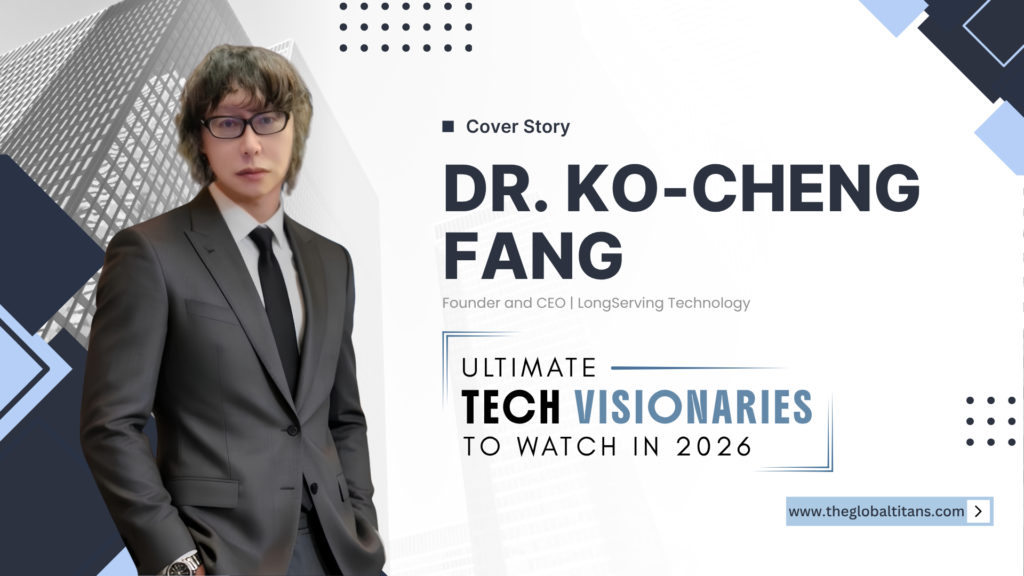
Dr. Ko-Cheng Fang: Advancing the Frontiers of Technology Through Curiosity and Creative Vision
What if the limits of technology exist only because we have accepted them for too long?
For Dr. Ko-Cheng Fang, innovation begins with refusing to accept that the existing answer is the final one.
Long before becoming an inventor and entrepreneur, he developed what he describes as the most enduring part of his thinking: “challenging existing frameworks and learning independently.” During his studies, he disliked standardized classroom teaching and predefined academic boundaries. He studied textbooks independently and moved freely across fields, from gongbi painting, oil painting, and sculpture to physics, materials science, and electronic engineering.
When traditional beliefs or authorities said, “this cannot be done” or “this is impossible,” he did not simply accept the answer.
He experimented.
He created.
He verified things for himself.
That naturally stubborn, artist-like personality became the foundation of an innovation philosophy built around independent thinking, interdisciplinary learning, and the courage to explore the unknown.
For Fang, the true value of innovation lies in solving real-world problems without fearing difficulties.
A Mind That Refuses to Stay in One Field
Fang’s journey has crossed cybersecurity, digital access control, photonic computing, advanced materials, biotechnology, AI robotics, and other deep-tech fields.
It began with a fundamental question in cybersecurity:
How can security be balanced with convenience?
To address data management and cyber threats, he developed an architecture for sending databases to remote secure servers along with a password-based locking system. These innovations became part of foundational concepts underlying modern cloud security and, according to Fang, were adopted by the U.S. Department of Homeland Security.
The experience also brought an unexpected chapter. Because of confidentiality agreements and security threats, he once had to live and work anonymously and eventually stepped away from research and development for a period of time.
Rather than ending his pursuit, the experience reinforced another principle: technology that goes beyond its time must be accompanied by strategic planning and a strong awareness of self-protection.
Eventually, he returned to the laboratory.
His research expanded into areas including “Lab-grown Imperial Jadeite” and photonic computing, where he began challenging the physical limitations of conventional electronic chips.
Rebuilding the Architecture of Computing
Fang’s belief that conventional limits can be challenged became especially pronounced as semiconductor technology approached increasingly difficult physical constraints.
As major manufacturers entered one and two nanometer scaling processes, Fang focused on what he describes as the inevitable bottleneck of the quantum tunneling effect.
He compared the limitations of conventional electronic chips and micron-scale silicon photonics to “trying to fit a Boeing 747 into a narrow alley.”
Traditional architectures, in his view, also face memory wall limitations, energy consumption, and heat dissipation challenges.
His response was not to make minor modifications.
It was to fundamentally reconstruct the system through materials and geometric architecture.
That work led him toward what he calls X-photon materials, photonic CPUs, and all-optical memory.
Fang says he developed X-photon materials with wavelengths as short as two to three nanometers and explored 90-degree vertical turns in optical paths, with the goal of achieving computing performance dramatically beyond conventional systems.
The breakthrough changed how he understood the limits of technology.
“Technology should not be restricted by existing textbooks and academic frameworks.”
For Fang, the objective is not simply a faster chip.
It is the possibility of fundamentally changing the architecture of computing.
When Different Disciplines Become One Advantage
What distinguishes Fang’s approach is not only the individual technologies he pursues, but the way he combines disciplines that are rarely developed together.
LongServing brings physics, computation, biology, materials, and creative innovation into one ecosystem because, in Fang’s view, individual disciplines increasingly encounter their own bottlenecks.
Materials science can unlock new possibilities for computing.
Computing architecture can translate those materials into new systems.
Creative thinking can connect ideas that traditional disciplines might keep separate.
He describes this as a multiplier effect.
When materials science, photonic architecture, and creative innovation intersect, Fang believes new all-optical ecosystems can emerge with the potential to reshape AI infrastructure and future computing.
For him, crossing disciplines is not random experimentation.
It is about building a more sustainable and efficient future ecosystem.
“The intersection of different disciplines can create a multiplier effect.”
Innovation Must Serve Humanity
Behind the technical ambition is a broader philosophy.
Fang believes scientific possibilities should not be pursued simply because they are commercially attractive or personally impressive.
They should be guided by “the long-term value to human civilization and the next generation.”
Truly valuable breakthroughs, he argues, should address major challenges facing humanity, improve quality of life, and create more efficient and sustainable solutions.
That philosophy connects his seemingly different areas of research.
Laboratory-grown imperial-green emeralds, X-photon materials, photonic CPUs, AI robotics, and advanced materials may appear unrelated on the surface.
For Fang, however, the connection is clear:
breaking through existing material and physical limits and solving major problems for humanity’s future through original technologies.
The Hardest Problem May Be Conviction
For an inventor working ahead of the market, the most difficult challenge is often not building the technology.
It is overcoming the belief that the technology cannot exist.
Fang describes encountering skepticism from traditional academia when moving into biotechnology, advanced materials, and other unfamiliar areas.
He has repeatedly encountered reactions that an idea was “impossible” or “violated science.”
His response has been consistent: learn independently, experiment, and verify.
But another challenge exists beyond academia.
The market itself may not be ready.
When a technology moves too far ahead of its time, the necessary design software, manufacturing ecosystem, equipment, talent, and business models may not exist.
In photonic computing, Fang says he encountered precisely this problem.
Rather than waiting for the ecosystem to appear, he chose to design and modify equipment himself, using strong execution to move ideas from concept toward reality.
This is where invention becomes entrepreneurship.
Creating a breakthrough is only the beginning.
Building the supporting ecosystem is what allows it to reach the market.
The Computing Shift Fang Sees Ahead
Looking toward 2026 and beyond, Fang believes one of the most fundamental technological transformations could be the transition from traditional silicon-based electronic computing toward X-photon computing.
He views this not as a minor upgrade, but as a reconstruction of the underlying physical architecture.
In his vision, X-photon materials and all-optical memory could help address limitations around resistive heating, energy consumption, transmission delays, and the memory wall.
He believes this could have major implications for semiconductors, AI infrastructure, and the future of computing.
The larger objective is clear.
Create technology with enough foundational impact to change what future systems are capable of doing.
“Never lose your imagination, dare to challenge existing frameworks and authority, and personally verify what seems impossible.”
A Future Built on Imagination
Outside the laboratory, Fang points to two experiences that profoundly influenced his innovation philosophy.
The first was his work involving the U.S. Department of Homeland Security, which taught him that technology capable of moving beyond its time requires strategic planning, discretion, and self-protection.
The second was much quieter.
Fishing alone while facing the vast ocean taught him patience, calm endurance, and the ability to continue repeating the process without panic or confusion.
Together, those experiences strengthened his willingness to challenge tradition without fearing ridicule from the outside world.
That mindset ultimately leads back to the principle at the heart of his work.
Do not let existing systems define the boundaries of your imagination.
Do not accept authority as a substitute for verification.
Do not confuse unfamiliarity with impossibility.
Fang’s journey from cybersecurity into photonic computing, advanced materials, biotechnology, and AI robotics reflects a consistent belief that innovation belongs to those willing to cross boundaries others consider fixed.
His vision is ambitious, but the philosophy beneath it is remarkably simple.
Keep learning. Keep questioning. Keep building.
And when the world says something cannot be done, personally verify it.
Dr. Ko-Cheng Fang’s Core PrinciplesInfographic Placeholder 3: Dr. Ko-Cheng Fang’s Core Principles
- Challenge existing frameworks.
- Learn independently.
- Think across disciplines.
- Verify what seems impossible.
- Build the ecosystem, not only the invention.
- Pursue technology for long-term human value.
- Never lose your imagination.
Ultimately, Fang hopes future generations inherit more than individual inventions from his life’s work.
He wants them to inherit the courage to think independently.
As long as they are heading in the right direction, with strong perseverance and continuous learning, what may initially appear to be a wild fantasy can become reality and create genuine value for humanity.
For Dr. Ko-Cheng Fang, the future of technology begins not with what the world already believes to be possible, but with the imagination to ask what comes next.
Quick Takes
One habit that has most strengthened your ability to innovate: meditation and have the courage to challenge existing frameworks.
One principle you refuse to compromise when creating technology: Never be limited by existing theories; persist in independent research and development and interdisciplinary thinking to solve real-world problems for humanity.
One technological possibility the world is still underestimating: Achieve all-optical computing using X-photon materials, increasing computing power by more than 1,000 times while reducing energy consumption by more than 90%
One invention or discovery that permanently changed how you see the future: Floating metals and anti-gravity devices. They break through the limitations of gravity, allowing humans to fly across seas and mountains like birds, completely transforming the boundaries of transportation and human life.
One scientist, inventor, book, or idea that profoundly influenced you: Nikola Tesla, the father of alternating current. His relentless pursuit of excellence in research and development, as well as his insight gained through meditation, deeply inspired me. He reminded me that I do not need to be constrained by existing systems, but should persist in self-directed learning and independent thinking, personally verifying and achieving breakthroughs that may seem impossible.