
Seshadri Vangala
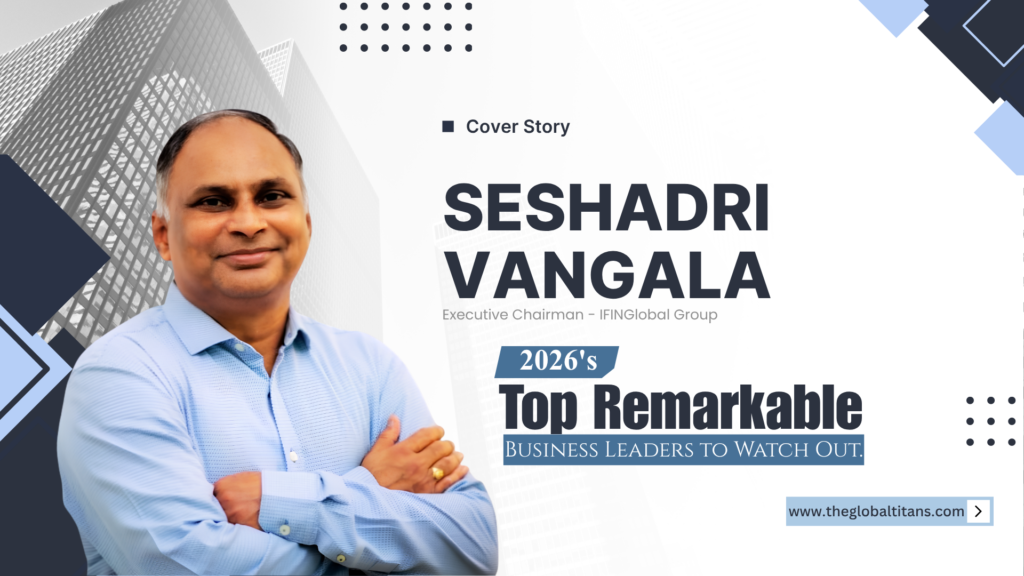
Seshadri Vangala: Global Workforce, Talent & Transformation Leader
Building Global Opportunity at the Intersection of Talent, Technology, and Transformation
Some leaders build companies.
Others build systems.
The rare ones do both while using those systems to create opportunities far beyond their own organizations.
Seshadri Vangala’s journey from a Mechanical Engineering graduate with a conventional ambition to an entrepreneur working across talent, technology, workforce transformation, and global business reflects that evolution.
At the beginning of his career, he viewed talent largely through academic qualifications and technical skills. Leadership seemed to belong to naturally gifted individuals, people born with qualities that made others follow them.
That understanding changed when he met his mentor, Dr. Kishore Prabhala.
Prabhala saw potential in Seshadri before he recognised it himself. He encouraged him to consult while still an undergraduate, publish papers, present at international forums, travel to the UK, and most importantly, develop confidence in public speaking and networking.
The experience revealed a powerful truth.
Many abilities people call “talent” are actually capabilities that can be developed when someone receives the right guidance and the opportunity to practice.
That lesson became the foundation of Seshadri’s leadership philosophy.
Leadership is about enabling transformation in others.
From Engineer to Entrepreneur
Seshadri’s corporate career included building and leading talent functions at organisations such as Deloitte, HP, and HCL, including global roles.
Those experiences taught him that talent is not simply an HR responsibility.
People ultimately drive every other function, whether finance, technology, operations, or business development.
Corporate leadership also allowed him to develop what he describes as an entrepreneurial mindset within an organisation. He learned to take ownership, build teams, solve problems, and lead initiatives as an intrapreneur while working within established systems and processes.
Eventually, that experience gave him the confidence to become an entrepreneur.
The transition brought a different reality.
Corporate environments generally provide defined budgets, established systems, teams, and resources.
Entrepreneurship requires building those resources yourself.
Funding, bandwidth, people, priorities, and execution suddenly become personal responsibilities.
One of the most important lessons was that there will always be more things worth pursuing than there are resources to execute.
Trying to do everything at once is not the same as making progress.
Seshadri learned to identify super priorities, create clear milestones, and focus resources on what matters most at each stage.
The corporate world taught him how to build and lead within a system.
Entrepreneurship taught him how to create the system itself.
“Entrepreneurship is not about having unlimited resources; it is about knowing how to prioritise the resources you have.”
A Global Citizen Grounded in Integrity
Seshadri has travelled to more than 50 countries, lived across four continents, and worked with people from diverse cultural and professional backgrounds.
Those experiences broadened his perspective while reinforcing one principle that has never changed:
Uncompromising integrity.
Regardless of the organisation, country, or culture, he believes leadership must remain grounded in strong ethics, morals, and transparency.
Circumstances change.
Principles should not.
What has evolved is his understanding of how leadership must be practiced.
You cannot lead everyone in exactly the same way.
You have to listen, understand, respect differences, adapt to cultural contexts, and find ways to bring people together around a shared purpose.
Living across different parts of the world also reinforced a broader belief that despite cultural and economic differences, people have many common aspirations.
That perspective became part of his philosophy of “One World, One Family.”
Today, that purpose extends beyond business.
Seshadri is increasingly focused on economic empowerment, women’s empowerment, the United Nations Sustainable Development Goals, and creating opportunities for underprivileged students.
The question is no longer only how to build successful organizations.
It is how experience, networks, and resources can be used to make the world a better place.
Where Talent Meets Technology
The intersection of Talent, Technology, and Transformation has become central to Seshadri’s vision for the future of global workforce solutions.
His experience across markets taught him that talent cannot be approached identically everywhere.
Regional talent must be understood within its local context.
Global talent requires knowledge of the cultural, professional, and business environment in which it operates.
Technology is making it possible to bridge those differences much more effectively.
AI, cloud platforms, automation, and advanced data analysis can bring together information from multiple sources and help organisations understand the parameters they need to consider before entering new markets.
But technology does not replace local expertise.
It makes that expertise more scalable.
Researchers, talent specialists, and local experts provide the knowledge, judgement, and cultural understanding required to make technology meaningful. Their insights can then be captured within a platform and continuously enriched through technology.
This creates a different model of workforce transformation.
The objective is not replacing human talent with technology.
It is combining human expertise with technology to improve the speed, scale, and quality of decision-making.
Talent provides knowledge, judgement, and human understanding.
Technology provides the ability to organise, analyse, scale, and execute that knowledge efficiently.
The ultimate objective is to help organisations operate globally without losing sight of local realities.
“Technology should be the catalyst. Humans should remain at the centre.”
From Ideas to Scalable Businesses
Seshadri believes many people have good ideas.
The real challenge is turning an idea into something that creates value in the market.
An excellent product or solution can remain an idea if it cannot reach the right market and be executed effectively.
Execution is the key to innovation.
The first milestone is understanding whether there is a genuine market need.
Entrepreneurs can fall in love with their own ideas and assume customers will automatically want them. Seshadri takes a different approach.
Understand the problem.
Understand the customer.
Determine whether the market is willing to pay.
For him, the first paying customer is one of the most important forms of validation because it demonstrates that an idea has moved beyond theory.
From there, the challenge becomes execution.
The right team.
The right network.
Industry knowledge.
Focus.
Resilience.
And the willingness to learn when things do not work as expected.
As the business develops, those lessons must become a repeatable model.
Processes need to be established so the business does not depend entirely on individual effort.
That was the approach Seshadri followed in building his own business.
Despite having significant industry experience, he deliberately started with one market, India. The objective was to understand the challenges, test solutions, learn from experience, and establish a benchmark before expanding internationally.
That experience contributed to the development of a broader global workforce solutions platform.
For Seshadri, sustainable scaling means starting with a real problem, validating the solution, executing well, learning continuously, and then building a model capable of creating the same value at a much larger scale.
Seeing Opportunity Inside Problems
Entrepreneurs encounter opportunities everywhere.
But Seshadri believes the best ones are often hidden inside problems.
When people consistently come forward with the same challenge, it is worth paying attention.
A genuine problem can point toward a genuine opportunity.
At the same time, not every opportunity deserves attention.
There will always be new ideas, partnerships, markets, and possibilities.
Trying to pursue everything ultimately dilutes focus and resources.
His approach is to evaluate each opportunity through the broader vision.
Does it fit the organisation’s core capabilities?
Is there the capability to execute it effectively?
Does it align with the long-term direction?
And is the timing right?
This creates a deliberate path to expansion.
Instead of entering every market simultaneously, the strategy is to establish one geography, build the necessary people, processes, and systems, make the operation scalable and self-sustaining, and then turn attention toward the next market.
For Seshadri, spotting opportunity is not simply about seeing what could be done.
It is about recognising what should be done, deciding when to do it, and having the discipline to focus until it creates results.
Information Inundation Is Not Intelligence
Seshadri sees the future of work being shaped by technology, artificial intelligence, changing employee expectations, and multiple generations operating together.
Technology has brought extraordinary benefits.
Communication is faster.
Information is more accessible.
Organizations can operate across geographies in ways that were previously difficult to imagine.
AI can become a powerful catalyst for productivity, decision-making, and employee experience.
Yet he believes businesses risk losing something important as everything becomes increasingly digital.
The human element of work.
The world now expects instant communication, instant information, and instant results.
But not everything valuable can or should happen instantly.
The workplace remains a human ecosystem.
Trust, empathy, collaboration, relationships, creativity, and judgement cannot be replaced simply by adding more technology.
Seshadri also identifies another challenge: information inundation.
There is more information available than ever before.
The difficulty is no longer accessing information.
It is determining what information is relevant, reliable, and useful.
That is why he believes organisations need to move from information inundation to information introspection, from consuming more information to understanding, filtering, and applying what actually matters.
Technology should help reduce the noise, not add to it.
Making Cross-Border Expansion Smarter
Entering a new market requires far more than identifying a commercial opportunity.
Organisations must understand the market, regulatory environment, culture, talent ecosystem, and business practices before making decisions.
The challenge is finding the balance.
Move too quickly and organisations may enter without adequate preparation.
Analyse for too long and the opportunity may disappear.
At IFIN Global Group, teams of market and subject-matter experts provide country-specific and regional knowledge across sectors and geographies.
Technology brings these inputs together into a dynamic platform connecting market intelligence with industries, clients, talent requirements, and business opportunities.
The platform currently covers around 30 countries, with plans to expand significantly over the next two years.
Seshadri’s model is straightforward.
Understanding the market. Accessing the right expertise. Acting at the right time.
Technology can accelerate the process.
Human expertise and local context make it meaningful.
Where Business Meets the Wider Ecosystem
Seshadri’s involvement with industry associations, chambers of commerce, trade missions, policymakers, and international stakeholders has added another dimension to his understanding of global expansion.
Through platforms including NASSCOM, CII, ASSOCHAM, and the London Chamber of Commerce, he has seen firsthand how policy, trade, business conditions, and sector-specific realities interact.
A country may appear attractive at a broad level, while individual sectors may face very different regulatory conditions, incentives, or opportunities.
That is why organisations need to understand the ecosystem they are entering, rather than relying only on broad country-level indicators.
For Seshadri, relationships among businesses, industry bodies, and policymakers create a bridge.
When those groups better understand one another, businesses can identify opportunities, anticipate challenges, and create more sustainable cross-border growth.
Creating Value Beyond Business
Perhaps the most personal part of Seshadri’s philosophy is the belief that opportunity should extend beyond those who already have access to it.
His own journey was shaped by a supportive family, strong mentors, friendships, and opportunities.
As he travelled and worked across markets, he also became increasingly aware of how many talented people, particularly from rural and underprivileged communities, lack access to the guidance and opportunities they need.
His response has been direct:
“We have to walk the talk.”
Mentorship has become an important part of his journey through initiatives focused on entrepreneurship, education, mentorship, and social development.
Programs supporting young people between eight and sixteen aim to identify aspirations early, expose them to possibilities beyond their immediate environment, and provide guidance and mentorship.
The underlying belief is powerful.
Opportunity is not always about financial support.
Sometimes the most valuable thing someone can provide is access to knowledge, networks, mentorship, and someone who believes in their potential.
Seshadri draws a distinction between financial value and human value.
Financial success can be measured in millions.
But touching a million lives carries a very different kind of value.
That is difficult to quantify.
It is also deeply meaningful.
“Success becomes more meaningful when it creates opportunities beyond yourself.”
One Family, One World, One Mission
After almost three decades across engineering, corporate leadership, entrepreneurship, talent, technology, and global business, Seshadri’s vision has expanded far beyond professional success.
He believes leadership is developed, practised, and ultimately measured by what it enables in others.
He believes technology should accelerate human capability, not diminish it.
He believes global growth should be grounded in local understanding.
And he believes the strongest businesses are those that create value not only for customers and shareholders, but also for people and communities.
That philosophy is captured in three words that have increasingly defined his work:
Talent. Technology. Transformation.
Talent brings knowledge, judgement, and human understanding.
Technology brings scale, speed, and intelligence.
Transformation brings the ability to turn both into lasting impact.
Together, they form the foundation of his larger philosophy:
“One Family, One World, One Mission.”
For Seshadri, the journey is still unfolding.
The goal is not simply to build larger organisations.
It is to create systems that connect people to opportunity, help businesses grow across borders, and turn experience into impact.
Because ultimately, the measure of leadership is not only what you build for yourself.
It is what becomes possible for others because you chose to build it.
Quick Takes
One leadership habit that has contributed most to your success
Listening before deciding.
I make it a habit to understand people, perspectives and the context before making a decision. This has helped me work across cultures, build strong teams and make better decisions. I have also learned that listening becomes valuable only when it leads to action.
One personal value that has been tested most throughout your journey
Integrity.
Across different organizations, cultures, markets and stages of my career, I have always believed that integrity cannot be compromised. Circumstances may change, but the principles with which we operate should not. For me, success has little meaning if it comes at the cost of ethics or trust.
One assumption about the future of work that you believe leaders should question
That more technology automatically means better work.
Technology and AI can make organizations faster and more efficient, but they cannot replace human judgement, empathy, relationships and context. Leaders should question the belief that technology is the answer to every workplace problem. The future of work should be technology-enabled, but it must remain human-centric.
One mindset shift that changed how you approach entrepreneurship
I stopped thinking about doing everything and started thinking about doing what matters most.
As an entrepreneur, there are always more opportunities and ideas than you have the resources to pursue. Learning to identify super priorities, focus on execution and build one successful model before scaling it changed the way I approach entrepreneurship. Scaling is not about doing more; it is about doing the right things consistently and then making them repeatable.
One person, book, experience, or idea that profoundly influenced your leadership
My mentor, Dr. Kishore Prabhala.
He saw potential in me before I could see it in myself. He pushed me beyond my comfort zone, particularly in public speaking, networking and academic work, and taught me that many abilities we consider “talent” can actually be developed through guidance and practice. His influence shaped my belief that leadership is ultimately about recognising potential in others and helping them transform it into capability.