
Yosi Kossowsky
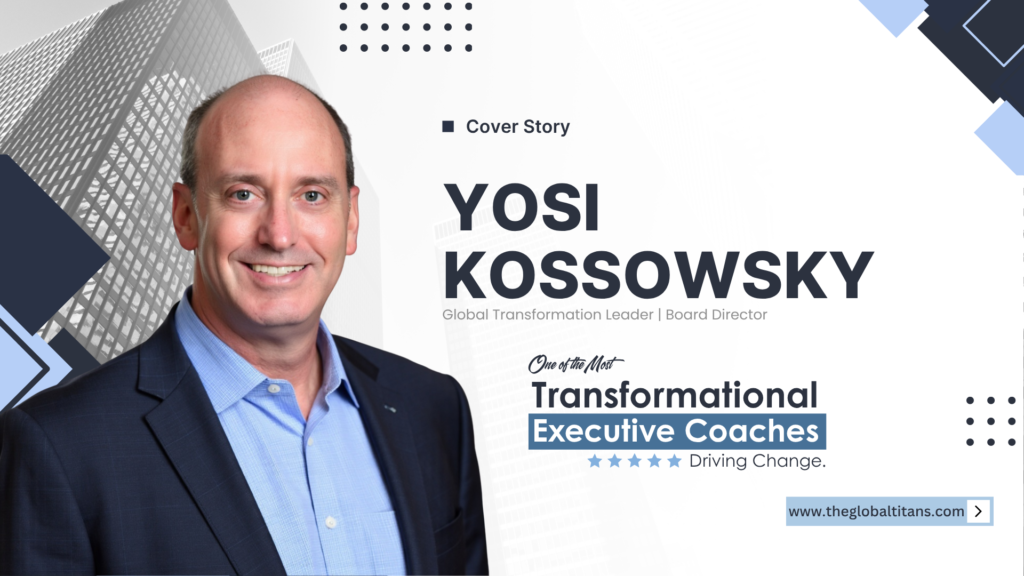
Yosi Kossowsky: Turning Self-Awareness into Courage, Clarity, and Lasting Change
“Leadership starts with self-leadership. We cannot change what we cannot see.”
For Yosi Kossowsky, leadership transformation begins somewhere many leaders are reluctant to look: within themselves.
His journey from engineering and technology into executive coaching was not simply a professional transition. It was shaped by his own experience of challenge, reinvention, and an enduring curiosity about human behavior. Across technical leadership, organizational transformation, and coaching, Yosi came to understand that many of the hardest problems inside organizations have surprisingly little to do with technology or strategy.
They are human problems.
Communication. Trust. Assumptions. Fear. Influence. Emotional patterns. The stories people tell themselves about what is possible.
Today, his work centers on helping leaders see what they cannot currently see, challenge the patterns shaping their behavior, and become more intentional about how they lead and live.
At the heart of that philosophy is a simple belief: people are capable of far more than they often realize.
A Personal Journey That Redefined Possibility
Growing up, learning did not come easily to Yosi.
He struggled with learning disabilities and often felt he had to work much harder than others simply to keep up. For more than 40 years, he carried a deeply limiting belief that something about him was broken.
Yet the experience that once shaped his self-doubt ultimately became one of the foundations of his understanding of human potential.
His own transformation took him from barely making it through school to eventually graduating university with honors.
The journey taught him two lessons that continue to shape his work today.
First, people are capable of far more than they often believe.
Second, we rarely know what challenges another person is carrying.
Growth, he discovered, becomes possible when people have the right support, greater self-awareness, and the willingness to challenge assumptions they may have carried for years.
That realization also sparked his lifelong fascination with human behavior, particularly why some people thrive through adversity while others remain trapped by patterns they may not even recognize.
Yosi Kossowsky’s Leadership Evolution
Earlier Perspective | Leadership Today |
Technical expertise | Human understanding |
Having the answers | Asking better questions |
Solving problems | Helping people think differently |
Logic first | Logic balanced with emotional intelligence |
Managing outcomes | Creating conditions for people to thrive |
From Engineering Systems to Human Systems
Yosi began his career in technology and engineering, eventually progressing into senior technical and operational leadership roles, including Senior Director of Talent Management and Chief Technology and Strategy Officer.
Early in his career, he believed technical expertise and problem-solving ability were the primary ingredients of leadership success.
Over time, reality challenged that assumption.
He could solve difficult technical and business problems, yet the challenges that increasingly determined success involved something different: communication, trust, influence, conflict, culture, relationships, and change.
A turning point came around 2005.
Being technically competent, Yosi realized, did not automatically make someone an effective leader.
“The technical side came to me naturally and intuitively, and the people side did not.”
He knew intellectually what a better communicator, influencer, and leader should do. The harder question was how to translate that knowledge into actual behavior, particularly under pressure.
That question led him into neuroscience, emotional intelligence, organizational development, coaching, and human behavior.
Eventually, his professional focus shifted.
He was still solving complex problems, but the systems had changed.
The systems he worked with now were human systems.
Leadership Starts with Self-Leadership
Yosi’s leadership philosophy today can be expressed simply:
Leadership starts with self-leadership.
Courage, clarity, and presence are not qualities people can simply talk themselves into developing. They emerge from understanding personal patterns, regulating emotions, questioning assumptions, and learning to respond intentionally instead of operating on autopilot.
For Yosi, lasting change begins with self-awareness because people cannot change what they cannot see.
This principle shapes how he coaches.
His role is not to provide all the answers.
It is to help people recognize what they currently cannot see so they can make better choices.
One of the most common mistakes he sees among leaders is attempting to change everyone around them before examining their own contribution to the situation.
A difficult employee.
A resistant team.
An ineffective stakeholder.
Those challenges may be real, but sustainable change often begins with a more uncomfortable question:
“How am I contributing to this situation?”
That question moves leadership away from blame and toward responsibility.
“The greatest impact is rarely a promotion or a performance metric. It is seeing someone fundamentally change how they show up in the world.”
Curiosity Before Judgment
If one practice sits at the center of Yosi’s approach, it is curiosity.
When situations become tense, people naturally move toward judgment, certainty, or blame.
Curiosity creates space.
It allows a leader to slow down, gather information, challenge assumptions, and better understand what may actually be driving a situation.
Yosi practices this internally as much as externally.
In tense moments, he first notices what is happening in his own body, perhaps a tightening in his jaw or chest, signals that his biochemistry has already shifted before he has said a word.
He breathes.
Names what he is feeling.
Creates space between emotion and action.
“Staying calm is not a personality trait for me. It is a practice.”
That small pause can become the difference between reacting automatically and choosing intentionally.
Neuroscience reinforces this approach. Many behaviors are automatic patterns rather than conscious decisions. Emotional awareness helps leaders notice those patterns before they dictate behavior, while curiosity creates room to choose differently.
People Are Not Spreadsheets
Yosi frequently works with highly intelligent, logic-driven, data-oriented leaders.
His message to them is straightforward:
People are not spreadsheets, and we are not mind readers.
Data matters. Analysis matters. Logic matters.
But human beings interpret reality through experiences, emotions, beliefs, values, and perceptions.
Leaders often assume they understand what someone meant or why they behaved a certain way. The brain fills gaps with its own story, and assumptions quickly become mistaken for facts.
The strongest leaders learn to slow down, check assumptions, and confirm understanding.
There is another difficult truth Yosi emphasizes:
You cannot argue someone out of how they experienced you.
Their experience is data.
Understanding human behavior does not make leadership less rigorous. It makes leadership more effective.
Four Leadership Patterns That Hold People Back
- Changing Others First Trying to fix employees or teams before examining personal contribution.
- Activity Over Effectiveness Staying busy solving problems without understanding them deeply.
- Remaining the Expert Continuing to have every answer when leadership now requires others to step forward.
- Mistaking Insight for Change Understanding a behavior intellectually without developing the ability to change it under pressure.
When Awareness Becomes Real Change
One coaching experience captures what meaningful transformation looks like to Yosi.
A highly capable senior technology executive was struggling to build trust with peers.
Their coaching focused on difficult but fundamental areas: self-awareness, communication, and leadership presence.
Over time, colleagues began describing the same leader differently.
Collaborative.
Approachable.
Influential.
The most meaningful change was not a title or performance metric. It was how other people experienced working with that leader.
One client described his own behavioral transformation as “clawing at himself not to fill the silence” and allowing someone else to step forward instead.
For Yosi, that captures the essence of sustainable change.
When leaders can recognize their own pattern while it is happening and deliberately choose something different, the change becomes theirs to keep.
Why Organizational Change Fails to Stick
Organizations have become increasingly sophisticated at diagnosing change.
They conduct assessments, redesign structures, organize leadership offsites, and create implementation plans.
Yet many transformations still fail to last.
Yosi believes leaders often underestimate the human side of change.
Processes and timelines receive enormous attention, while emotions, identity, habits, culture, and deeply established behavioral patterns receive far less.
Organizations become good at identifying what needs to change without building the structures necessary to turn insight into new habits.
Sustainable transformation requires people to understand why change matters, how it affects them, what is in it for them, and what support they need to succeed.
Change cannot simply be announced.
It must be practiced.
Leading in an AI-Driven Future
As leadership moves toward 2027 and beyond, Yosi sees four forces becoming increasingly important: artificial intelligence in leadership and decision-making, greater complexity and uncertainty, the growing importance of emotional intelligence, and the challenge of leading across generations, cultures, and hybrid environments.
As technology automates more technical work, distinctly human capabilities become more valuable.
Empathy.
Judgment.
Trust.
Self-awareness.
Adaptability.
The ability to navigate complexity through relationships.
“The future belongs to leaders who can combine strategic thinking with human understanding.”
The Human Leadership Advantage
Self-Awareness → Curiosity → Emotional Regulation → Better Choices → Trust → Sustainable Change
The Courage to Keep Looking Within
For emerging coaches and leaders, Yosi’s advice begins where his own transformation began.
Start with yourself.
“You cannot take someone to a place you have not been yourself.”
Do the inner work. Listen deeply. Stay curious longer. Become comfortable without immediate answers.
Growth rarely comes from simply telling people what to do.
It comes from helping them discover what they are capable of becoming.
Yosi’s journey from a young person struggling with learning to an engineer, technology executive, organizational leader, and executive coach reflects that philosophy in deeply personal terms.
Perhaps that is why his approach to leadership ultimately returns to something remarkably simple.
The most powerful thing we can offer another person may not be an answer.
It may be the willingness to remain genuinely curious long enough to truly understand them.
Because in leadership, coaching, and life, the quality of our questions may ultimately matter more than the quality of our advice.
Quick Takes
- A) One leadership habit that has most contributed to your success
Curiosity before judgment.
I’ve learned that the quality of my leadership is directly tied to the quality of the questions I ask. Before jumping to conclusions, I try to understand what I might be missing. Whether I’m coaching a leader, facilitating a team discussion, or navigating a difficult situation, curiosity helps me see beyond assumptions and make better decisions.
- B) One personal value that guides both your life and your coaching work
Growth through self-awareness.
I believe meaningful change starts when we become aware of the patterns, beliefs, and behaviors shaping our actions. I try to live by that principle myself and help my clients do the same. We cannot change what we cannot see, and self-awareness is often the doorway to both personal and professional growth.
- C) One challenge transformational coaches must prepare for in the next decade
Helping leaders remain deeply human in an AI-driven world.
Technology will continue to accelerate decision making, automate tasks, and increase efficiency. The challenge for coaches will be helping leaders strengthen the uniquely human capabilities that technology cannot replace, including intuition, empathy, judgment, trust building, self-awareness, and the ability to navigate complexity through relationships.
- D) One mindset shift that helped you evolve from technologist to coach
From solving problems to helping people think differently about them.
As an engineer, I was rewarded for having answers. As a leader, I realized that knowing “what to do” is not the same as being able to do it. And as a coach, I’ve learned that lasting change rarely comes from giving advice. It comes from helping people see themselves, their challenges, and their possibilities from a new perspective. That shift transformed not only my coaching but also my leadership.
- E) One book, influence, or resource every emerging leader should explore
“Leadership and Self-Deception” by The Arbinger Institute.
Many leadership challenges are not really about strategy, communication, or execution. They stem from how we see ourselves and how we see and treat others. This book offers a powerful perspective on blind spots, assumptions, and the ways we unintentionally create the very problems we’re trying to solve. It’s one of the most practical books I’ve found for developing self-awareness and improving relationships.